
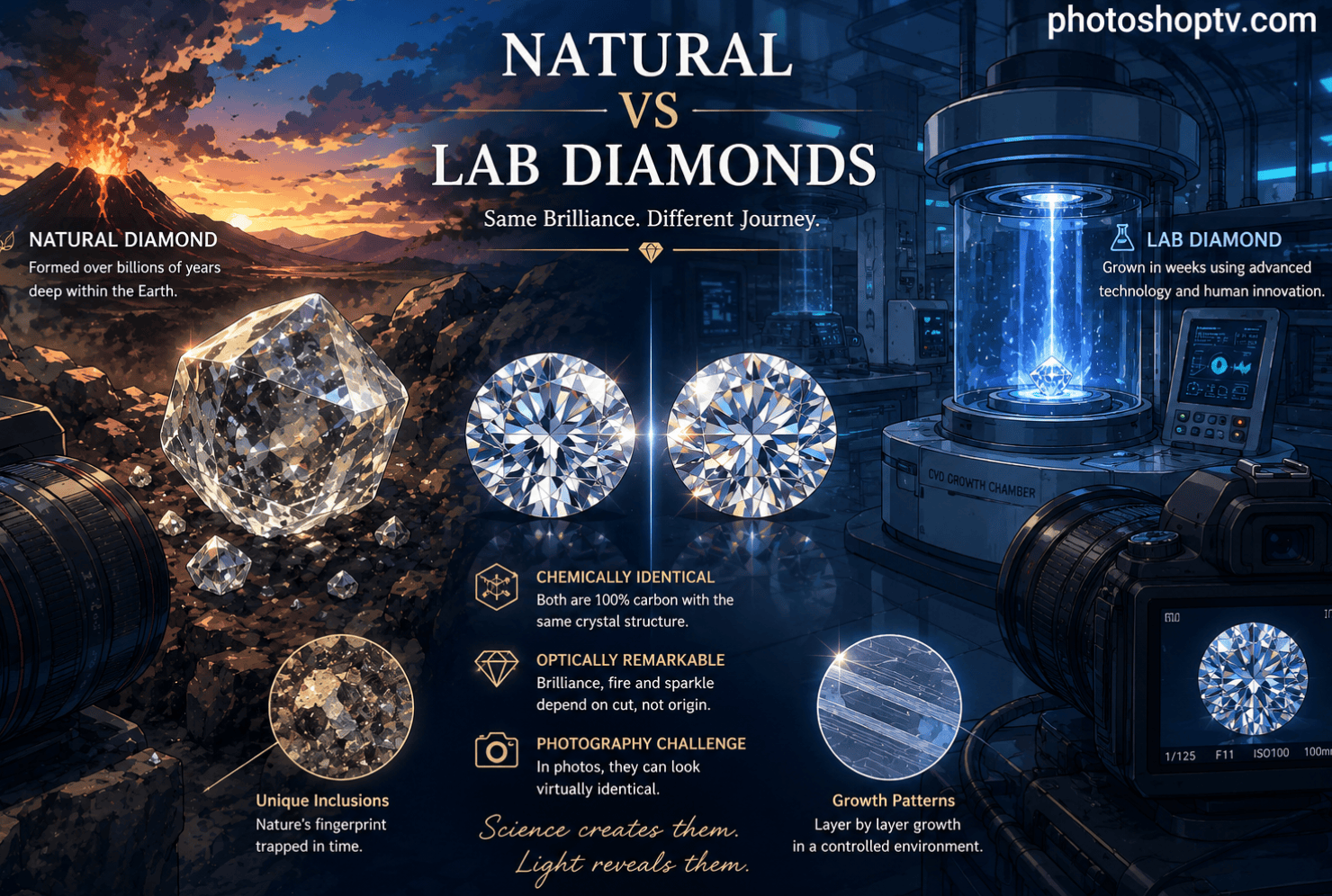
Walk into a jewelry store today and there is a good chance you will find both natural diamonds and laboratory-grown diamonds sitting side by side. To the naked eye they often appear identical. Under a camera lens they can appear identical as well. Yet their stories could not be more different.
One diamond may have spent over a billion years deep beneath the Earth’s surface before reaching daylight through an ancient volcanic eruption. The other may have grown inside a sophisticated laboratory in only a few weeks.
At PhotoshopTV we enjoy exploring subjects where science meets visual storytelling. Diamonds are a perfect example. They challenge photographers, fascinate geologists and occasionally leave gemologists scratching their heads. The camera records what it sees but it cannot always reveal the remarkable journey behind the sparkle.
What Is a Natural Diamond?
A natural diamond forms deep inside the Earth’s mantle where carbon is exposed to extraordinary heat and pressure.
Over hundreds of millions or even billions of years carbon atoms slowly arrange themselves into a crystal lattice. Eventually powerful volcanic eruptions transport these crystals closer to the surface through structures known as kimberlite pipes.
Every natural diamond represents an extraordinary chapter in Earth’s geological history.
When someone says a diamond is “old” they are often making the understatement of the century.
What Is a Laboratory Diamond?
A laboratory-grown diamond is also real diamond.
That sentence surprises many people.
Lab diamonds are not cubic zirconia. They are not crystal glass. They are not diamond imitations.
They consist of the same carbon atoms arranged in the same crystal structure as natural diamonds.
The only significant difference is where they formed.
Instead of growing deep inside the Earth they are produced inside highly controlled laboratory equipment using advanced scientific methods.
Two Different Growth Methods
Scientists primarily use two techniques to grow diamonds.
High Pressure High Temperature
High Pressure High Temperature or HPHT attempts to recreate the conditions found deep within the Earth’s mantle.
Carbon experiences tremendous heat and pressure before beginning to crystallize around a tiny seed.
The process is surprisingly similar to nature except that it happens inside specialized industrial equipment rather than beneath continents.
Chemical Vapor Deposition
Chemical Vapor Deposition or CVD takes a different approach.
Carbon-rich gases fill a chamber where energy separates the carbon atoms.
Those atoms slowly attach themselves to a thin diamond seed layer.
The crystal grows one microscopic layer at a time until a complete diamond forms.
Watching the process is almost like watching frost slowly develop on a winter window except the final result is one of the hardest materials on Earth.
Are They Chemically Different?
No.
Chemically they are both carbon.
They share the same crystal structure.
They have nearly identical hardness.
They exhibit similar brilliance.
They can receive the same cuts including Round Brilliant Princess Oval Emerald Cushion Pear and many others.
If someone hands you two loose diamonds there is an excellent chance you would never know which is natural.
Can Jewelers Tell the Difference?
Sometimes.
Experienced gemologists often notice subtle clues under magnification.
Growth patterns.
Metallic inclusions.
Internal strain.
Minute fluorescence characteristics.
Even then many diamonds require advanced laboratory equipment before an origin can be confirmed with confidence.
This is one reason grading laboratories play such an important role within the diamond industry.
Can a Camera Tell the Difference?
Here comes the fun part.
Usually not.
Modern cameras capture reflected light.
They record brilliance.
Contrast.
Color.
Reflections.
Sparkle.
They do not capture the geological history hidden inside the crystal.
A perfectly photographed natural diamond and an equally well photographed laboratory-grown diamond may produce images that appear virtually indistinguishable.
The camera remains wonderfully impartial.
Why Diamond Photography Is Surprisingly Difficult
Diamonds refuse to behave like ordinary photographic subjects.
A portrait sits still.
A landscape politely waits.
A diamond becomes a tiny optical circus.
Every facet behaves like a microscopic mirror.
Light enters.
Light bends.
Light exits again in unexpected directions.
One small movement of a light source can completely transform the image.
Professional gemstone photographers spend remarkable amounts of time adjusting reflectors diffusers and lighting angles before pressing the shutter.
The final photograph often represents hours of careful preparation.
Lighting Makes Every Diamond Look Better
Whether natural or laboratory-grown lighting remains the single most important ingredient.
Soft diffused lighting reveals facet definition.
Controlled directional lighting creates brilliance.
Carefully positioned reflectors produce attractive highlights.
Large softboxes often outperform direct flash because they create smoother reflections across polished surfaces.
The secret is rarely brighter light.
The secret is better light.
Macro Photography Changes Everything
At normal viewing distance two diamonds may appear identical.
Under a macro lens an entirely different universe appears.
Tiny inclusions.
Minute polishing marks.
Facet junctions.
Crystal growth features.
Dust particles that suddenly resemble giant boulders.
Photographing diamonds teaches patience because every microscopic imperfection becomes visible.
Many photographers spend more time cleaning the stone than operating the camera.
Polarized Light Reveals Hidden Stories
Scientists occasionally photograph diamonds using polarized light.
This technique reveals internal stress patterns that ordinary lighting cannot show.
Natural diamonds often display different stress structures than laboratory-grown examples.
These colorful patterns are scientifically fascinating although they rarely influence everyday appearance.
They remind us that every diamond carries an invisible record of its formation.
Do They Sparkle Differently?
This question appears constantly online.
The answer is generally no.
Sparkle depends primarily on cut quality.
An exceptionally cut laboratory-grown diamond will usually outperform a poorly cut natural diamond.
Likewise an exceptionally cut natural diamond can display breathtaking brilliance regardless of its age.
The cutter often deserves as much credit as nature.
The Role of Diamond Cut
Think of the rough crystal as the raw material.
The cutter becomes the sculptor.
Every facet angle influences how efficiently light travels through the diamond.
Excellent symmetry.
Precise proportions.
Careful polishing.
These characteristics determine whether a diamond appears lively or lifeless.
Even billions of years cannot compensate for poor craftsmanship.
Can Artificial Intelligence Identify Them?
Researchers continue exploring this possibility.
Machine learning systems analyze enormous collections of gemstone images searching for patterns invisible to human observers.
While AI shows promise most professional laboratories still combine imaging with sophisticated scientific testing before determining origin.
A photograph alone rarely provides enough information.
Why This Subject Fascinates Photographers
Photographers love visual puzzles.
Natural and laboratory-grown diamonds create one of the most interesting puzzles of all.
Two gemstones.
Nearly identical chemistry.
Nearly identical optical performance.
Completely different histories.
The challenge shifts from simply capturing sparkle to understanding what the camera cannot record.
Sometimes the most interesting part of a photograph is the story that remains invisible.
Choosing Between Natural and Laboratory Diamonds
Every buyer approaches the decision differently.
Some appreciate the extraordinary geological history behind natural diamonds.
Others value the technological achievement represented by laboratory-grown diamonds.
Some prioritize rarity.
Others focus on size within a given budget.
Neither choice changes the fundamental challenge for photographers.
Both demand exceptional lighting careful composition and enormous attention to detail.
The Unexpected Similarity
Perhaps the biggest surprise is how much these two worlds overlap.
One diamond began growing long before mammals existed.
The other may have started growing only months ago.
Yet when both sit beneath carefully controlled studio lighting they perform remarkably alike.
That is one of the great ironies of diamond photography.
The lens celebrates what they have become rather than where they came from.
Final Thoughts
Natural and laboratory-grown diamonds tell two completely different stories using the same visual language. One story begins deep beneath ancient continents. The other begins inside laboratories filled with advanced technology. Both ultimately produce extraordinary crystals capable of bending and reflecting light in spectacular ways.
At PhotoshopTV we enjoy exploring subjects that reward curiosity. Photography teaches us to look carefully while science teaches us to ask better questions. Diamonds combine both pursuits beautifully. Whether a crystal formed over billions of years beneath the Earth’s mantle or over several weeks inside a laboratory the camera still asks the same question every time the shutter opens.
How does this remarkable crystal dance with light?