
Diamonds have fascinated scientists, photographers and collectors for centuries. Their extraordinary brilliance often receives the most attention yet the real story begins long before a diamond reaches a jewelry store or appears in front of a camera. Every natural diamond is the result of an incredible geological journey that unfolds deep beneath the Earth’s surface over immense periods of time.
At PhotoshopTV we have always been interested in the way light shapes the world around us. Whether capturing a dramatic landscape or photographing a flawless diamond the same principles of illumination, contrast and optical precision apply. Understanding how diamonds grow not only reveals their geological history but also explains why they interact with light in such spectacular ways.
What Is Diamond Crystal Growth?
Diamond crystal growth is the natural process through which carbon atoms arrange themselves into one of the hardest known materials on Earth. Instead of forming soft graphite like the material found inside a pencil the carbon atoms bond together in an incredibly strong three dimensional crystal lattice.
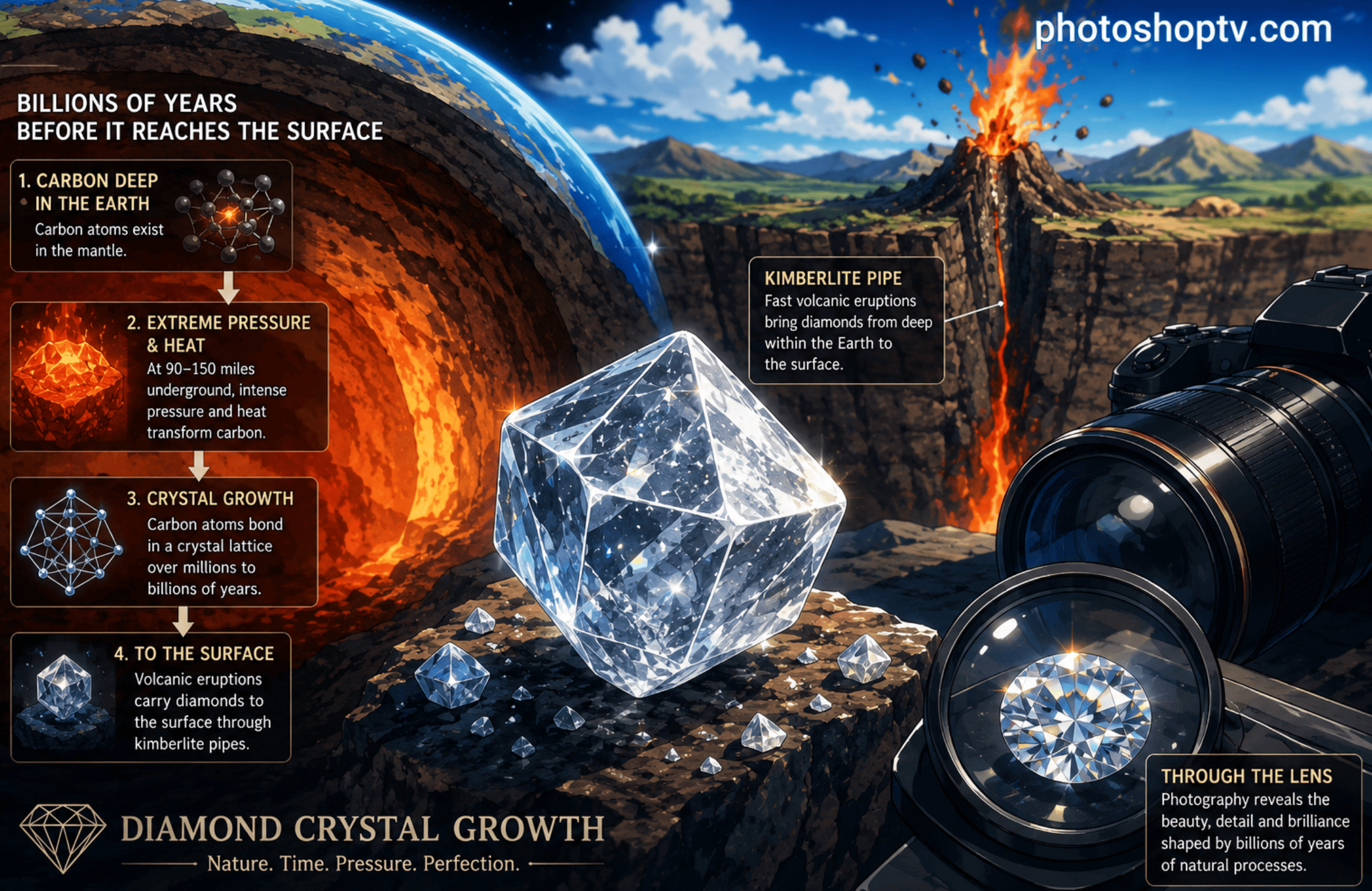
This crystal structure gives diamonds their remarkable hardness, exceptional durability and unique optical properties. Every polished diamond seen in an engagement ring began as a rough crystal growing slowly under conditions that humans cannot naturally reproduce outside specialized laboratories.
The Ingredients Needed to Grow a Diamond
Although diamonds consist almost entirely of carbon the environment required to create them is surprisingly demanding.
Several conditions must exist simultaneously:
- Extremely high pressure
- Temperatures exceeding 2,000°F (1,100°C)
- Large amounts of available carbon
- Long periods of geological stability
These conditions exist approximately 90 to 150 miles beneath the Earth’s surface inside the Earth’s mantle.
Only a very small percentage of carbon ever experiences these conditions which explains why natural diamonds remain relatively rare.
A Journey Lasting Hundreds of Millions of Years
One of the most fascinating aspects of diamond growth is time.
Many natural diamonds formed between one and three billion years ago. Some are considerably older than the dinosaurs while others existed before complex life developed on Earth.
During this immense period carbon atoms slowly attached themselves to the growing crystal. Layer after layer accumulated until rough diamond crystals eventually reached sizes large enough to become gemstones.
Some diamonds stopped growing early while others continued accumulating material for millions of years.
Every growth stage leaves microscopic fingerprints inside the crystal that gemologists can study today.
Different Diamond Crystal Shapes
Not every rough diamond looks the same.
Depending on the conditions during growth diamonds may develop into several different crystal forms.
Some of the most common include:
- Octahedrons
- Cubes
- Dodecahedrons
- Twinned crystals
- Irregular crystal combinations
These natural crystal shapes influence how cutters eventually transform rough diamonds into polished gems.
An experienced cutter studies the original crystal carefully before deciding how to maximize beauty and minimize material loss.
Tiny Imperfections Tell an Ancient Story
Natural diamonds often contain microscopic inclusions.
Rather than being flaws these tiny features frequently provide valuable information about the diamond’s formation.
Some inclusions are tiny mineral crystals that became trapped during growth. Others represent microscopic fractures or internal growth patterns created over millions of years.
For geologists these inclusions function almost like time capsules that preserve evidence of the Earth’s deep interior.
How Diamonds Reach the Surface
Growing deep underground is only part of the story.
Diamonds remain trapped inside the mantle unless powerful volcanic eruptions transport them toward the surface.
These eruptions create vertical structures known as kimberlite pipes.
Unlike ordinary volcanoes these eruptions happen extremely quickly. Scientists believe this rapid ascent is essential because diamonds would convert into graphite if they remained exposed to lower pressures while moving upward too slowly.
Today many of the world’s major diamond mines are located where ancient kimberlite pipes reach the surface.
Can Humans Grow Diamonds?
Yes.
Scientists developed methods for growing diamonds inside laboratories during the twentieth century.
The two primary techniques are:
High Pressure High Temperature (HPHT)
HPHT attempts to recreate the natural conditions found deep inside the Earth.
Carbon is exposed to tremendous pressure and heat until diamond crystals begin to form around a tiny seed crystal.
Chemical Vapor Deposition (CVD)
CVD takes a different approach.
Instead of recreating Earth’s mantle scientists introduce carbon rich gases into a specialized chamber.
The gases break apart and individual carbon atoms slowly attach themselves to a diamond seed layer by layer.
Although the process differs dramatically from nature the resulting crystal is still diamond.
Natural and Laboratory Growth
Natural and laboratory grown diamonds share the same crystal structure.
The difference lies primarily in where and how they formed.
Natural diamonds developed over geological timescales beneath the Earth’s surface.
Laboratory diamonds typically grow within several weeks inside carefully controlled facilities.
Modern gemological laboratories can usually identify the growth patterns associated with each origin because the microscopic structures differ even though both materials are chemically identical carbon.
Why Crystal Growth Matters for Photography
For photographers crystal growth is much more than geology.
It directly influences how a diamond interacts with light.
The remarkable sparkle associated with diamonds begins with the crystal itself. A well formed crystal allows cutters to produce precise facet arrangements that reflect and refract incoming light efficiently.
Without excellent crystal quality even perfect cutting cannot fully compensate.
Understanding crystal growth therefore helps explain why some diamonds appear brighter and more lively than others.
Photographing Rough Diamond Crystals
Rough diamonds present an entirely different photographic challenge compared to polished stones.
Instead of dramatic flashes of brilliance rough crystals often display subtle textures and geometric surfaces.
Photographers frequently use soft directional lighting to reveal:
- Natural crystal faces
- Growth patterns
- Surface texture
- Tiny inclusions
- Internal transparency
Strong direct flash usually hides these details by creating harsh reflections.
Diffused lighting produces far more informative images.
Why Lighting Is Everything
Diamonds behave differently from almost every other photographic subject.
Rather than reflecting only surface light they also bend light inside the crystal.
This means even tiny adjustments in lighting position can dramatically change the appearance of a diamond.
Professional gemstone photographers often spend far more time positioning lights than pressing the shutter button.
Small reflectors white diffusion panels and carefully controlled light sources allow individual facets to illuminate without overwhelming the image.
Macro Photography Reveals an Invisible World
Modern macro lenses allow photographers to explore details invisible to the naked eye.
High magnification reveals:
- Crystal growth lines
- Minute inclusions
- Tiny surface features
- Natural crystal geometry
- Internal reflections
Many educational gemstone photographs combine focus stacking with carefully controlled lighting to achieve exceptional sharpness across the entire crystal.
Without these techniques much of the fascinating microscopic world inside diamonds would remain hidden.
Polarized Light and Diamond Imaging
Some researchers photograph diamonds using polarized light.
This technique can reveal internal stress patterns that ordinary lighting cannot show.
Although these colorful stress images are mainly used for scientific research they also create visually striking photographs that demonstrate the complex internal structure of the crystal.
They remind us that every diamond possesses a unique internal architecture shaped during its formation.
Why Diamond Photography Requires Patience
Few photographic subjects demand as much precision as diamonds.
Dust particles become enormous at macro magnifications.
Tiny fingerprints instantly reduce brilliance.
Even slight camera movement can soften important details.
Professional gemstone photographers therefore work slowly while cleaning the stone repeatedly adjusting lights and capturing many exposures before selecting the strongest image.
Patience consistently produces better results than rushing.
The Intersection of Science and Art
Diamond crystal growth represents one of geology’s greatest achievements.
Photography allows us to appreciate that achievement visually.
Every image of a diamond captures more than a beautiful gemstone. It captures billions of years of geological history preserved inside an extraordinary crystal of carbon.
Understanding where diamonds come from adds another layer of appreciation whenever we see one sparkle beneath carefully positioned lights or magnified through a macro lens.
Final Thoughts
At PhotoshopTV we enjoy exploring subjects where science and visual storytelling intersect. Diamond crystal growth is a perfect example. The same curiosity that drives photographers to study lighting and composition also encourages us to understand the remarkable natural processes behind the objects we photograph.
The next time you admire a diamond image remember that the brilliance visible through the camera lens began deep inside the Earth long before the first human ever picked up a camera. Billions of years of crystal growth eventually became a polished gemstone and finally a photograph that captures one of nature’s most extraordinary creations.