
The world beneath our feet is constantly changing. Mountains rise and slowly disappear. Continents drift across the planet. Volcanoes erupt. Oceans open and close over hundreds of millions of years. Hidden within this remarkable geological engine another process quietly unfolds. Minerals slowly transform into gemstones that may one day become jewelry admired around the world.
Every emerald sapphire ruby opal and diamond has a story that begins long before human civilization. Some gemstones formed deep inside the Earth’s mantle while others developed in cooling magma or inside cracks where mineral-rich water flowed for millions of years. Although each gemstone follows a different path they all represent extraordinary examples of nature’s patience and precision.
At PhotoshopTV we enjoy exploring subjects where science and visual storytelling come together. Gemstones are fascinating because they combine chemistry geology color physics and photography into a single subject. Understanding how gemstones form also helps explain why they display such incredible colors textures and optical effects when viewed through a camera lens.
What Is a Gemstone?
A gemstone is a naturally occurring mineral or in some cases an organic material that possesses exceptional beauty durability and rarity.
Most gemstones consist of crystalline minerals whose atoms are arranged in highly ordered structures. These repeating crystal patterns determine many of the physical properties that make gemstones valuable including hardness transparency and the way they interact with light.
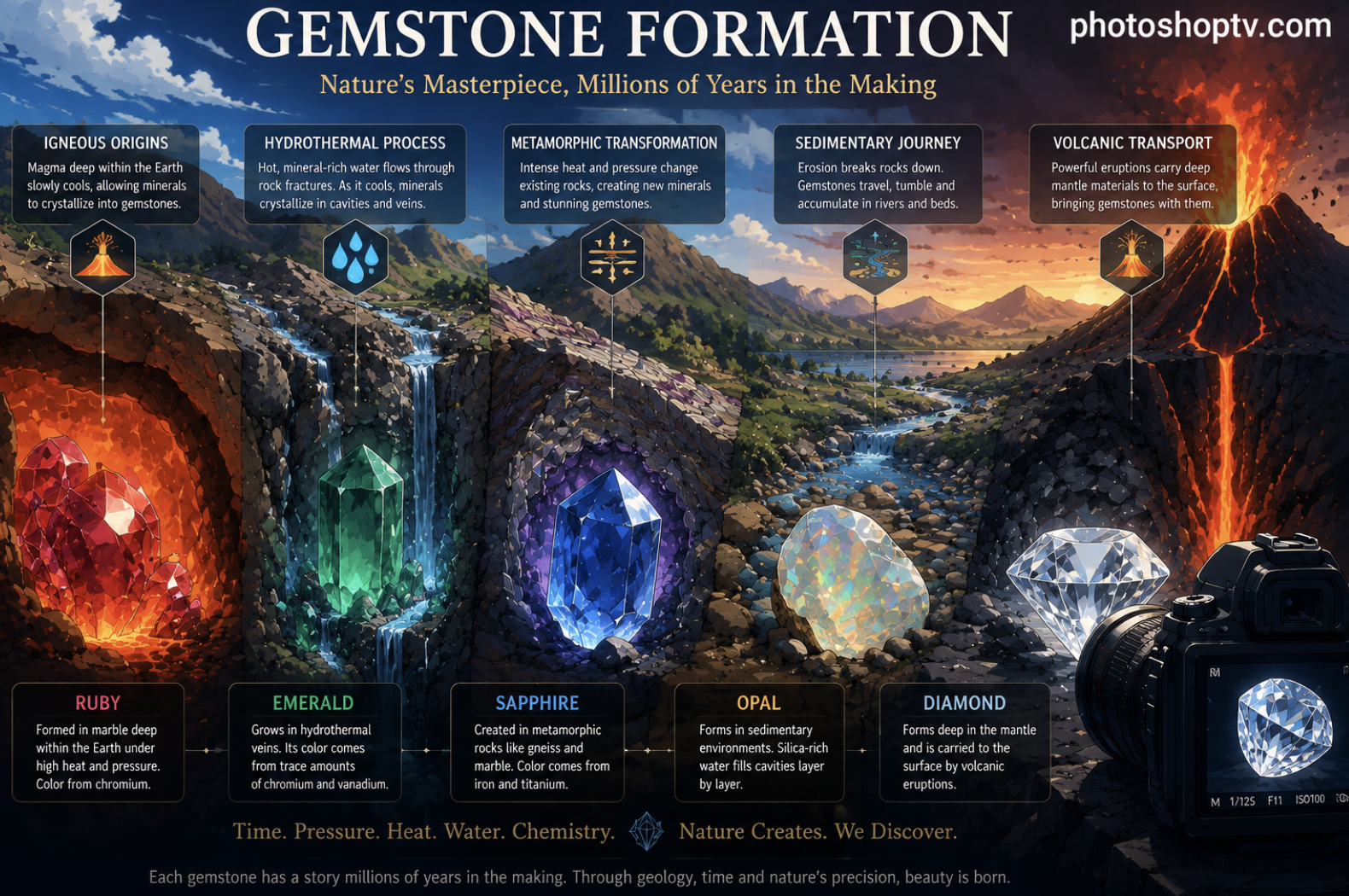
Not every crystal becomes a gemstone. Countless minerals form beneath the Earth’s surface every day yet only a relatively small number develop the clarity color and durability required to earn gemstone status.
Nature is surprisingly selective.
The Earth Is One Giant Geological Laboratory
Imagine the Earth as an enormous laboratory operating continuously for more than four billion years.
Heat rises from the planet’s interior.
Pressure constantly reshapes underground rock.
Water dissolves minerals before carrying them through microscopic fractures.
Molten magma slowly cools.
Entire mountain ranges form before erosion gradually wears them away.
Throughout these enormous cycles minerals crystallize under different conditions. Small changes in temperature pressure chemistry or available elements produce completely different gemstones.
The result is one of the greatest collections of natural artwork found anywhere in the universe.
Crystal Growth Begins One Atom at a Time
Every gemstone begins on an almost unimaginably small scale.
Individual atoms gradually join together following strict geometric patterns determined by chemistry.
Each newly arriving atom attaches itself to the growing crystal surface where it becomes part of an expanding three dimensional structure.
This process continues extremely slowly.
In some environments crystals grow over thousands of years.
Others continue developing for hundreds of millions of years.
Every layer preserves a tiny record of the conditions that existed during its formation.
Gemologists often describe crystals as geological history books written one atom at a time.
Heat and Pressure Shape the Underground World
Many gemstones owe their existence to enormous pressure and intense heat.
Deep beneath the Earth’s surface rocks experience conditions that would instantly destroy most materials found at the surface.
Atoms become mobile.
Minerals reorganize.
Existing crystals dissolve before new ones begin growing.
These transformations create opportunities for gemstones to develop under remarkably stable conditions.
The deeper scientists look the more extraordinary these geological environments become.
Magma Creates Some of the World’s Most Beautiful Gemstones
When molten rock slowly cools underground dissolved minerals gradually begin forming crystals.
Large underground magma chambers provide ideal conditions because cooling occurs very slowly.
The slower a crystal grows the more opportunity it has to develop into a large well formed gemstone.
Some varieties of topaz zircon tourmaline and beryl originated within these ancient igneous environments.
The crystal eventually becomes locked inside surrounding rock where it may remain for millions of years before erosion finally exposes it.
Water Is One of Nature’s Most Powerful Builders
Although people often associate gemstones with volcanoes water plays an equally important role.
Hot mineral-rich water moves through underground fractures carrying dissolved chemical elements.
As temperature and pressure change those dissolved minerals begin crystallizing along the walls of tiny cavities.
Layer after layer accumulates until complete crystals eventually fill the available space.
Many quartz crystals amethyst and numerous other gemstones formed through this remarkable hydrothermal process.
It demonstrates that gentle flowing water can accomplish astonishing geological work given enough time.
Metamorphic Rocks Create Extraordinary Conditions
Some gemstones develop when existing rocks experience tremendous pressure without completely melting.
Scientists refer to this process as metamorphism.
Existing minerals become unstable.
New minerals begin replacing older ones.
Entire crystal structures reorganize.
Rubies sapphires garnets jade and several other gemstones frequently owe their existence to these remarkable transformations.
The original rock may become almost completely unrecognizable after millions of years of metamorphic change.
Why Every Gemstone Has a Different Color
One of the greatest mysteries for many people is color.
Why is an emerald green while a ruby appears red?
The answer often lies in incredibly small amounts of trace elements.
Pure crystal structures frequently produce colorless minerals.
When tiny quantities of chromium iron titanium vanadium manganese or other elements become incorporated during crystal growth entirely new colors appear.
These concentrations may represent only a few atoms among millions.
Yet those few atoms completely transform the appearance of the gemstone.
Nature demonstrates that even the smallest ingredients can produce spectacular results.
Light Completes the Story
A gemstone’s beauty does not end when crystal growth finishes.
Its appearance depends equally on light.
Light enters the crystal before slowing changing direction reflecting internally and eventually returning toward the observer.
Each gemstone possesses its own optical personality.
Some display brilliant flashes.
Others produce soft glowing color.
Certain gemstones reveal silky textures while others create remarkable optical effects such as star patterns or shifting colors.
Without light much of a gemstone’s beauty would remain hidden.
Why Transparency Varies
Not every gemstone is perfectly transparent.
Some crystals contain microscopic inclusions.
Others developed tiny fractures during growth.
Additional minerals occasionally became trapped inside the crystal while it formed.
These natural features influence transparency.
Interestingly complete perfection is relatively uncommon.
Many collectors appreciate inclusions because they remind us that the gemstone formed naturally rather than emerging from a perfectly controlled industrial process.
Nature rarely creates absolute perfection and that is part of its charm.
The Geological Clock Never Stops
Gemstone formation rarely happens quickly.
Most gemstones require immense periods of geological stability.
During those long intervals mountains rise above them.
Rivers change direction.
Entire ecosystems appear before disappearing forever.
The crystal continues growing silently beneath the surface while life above changes countless times.
Looking at a finished gemstone therefore means looking into deep geological time.
Few natural objects connect us so directly with Earth’s ancient history.
Discovering Hidden Treasures
Most gemstones remain hidden inside rock until geological processes expose them.
Weather gradually breaks down mountains.
Rain transports sediments.
Rivers carry mineral fragments across great distances.
Eventually gemstones become concentrated within riverbeds ancient gravel deposits or exposed rock formations where miners may finally discover them.
Many famous gemstone deposits were first identified because local streams contained brightly colored crystals washed down from nearby mountains.
Nature often leaves subtle clues for those willing to observe carefully.
Gemstones Through the Camera Lens
Photography reveals details that many people never notice during everyday viewing.
Under controlled lighting gemstones display remarkable internal worlds.
Tiny inclusions become visible.
Growth structures emerge.
Color zoning appears.
Minute crystal faces reflect light with astonishing precision.
Macro photography transforms even familiar gemstones into entirely new landscapes filled with texture geometry and color.
A single crystal may contain enough visual complexity to inspire hours of careful observation.
Capturing Color Accurately
Gemstone photography presents unique technical challenges.
Many gemstones reflect light strongly while others absorb certain wavelengths.
Incorrect lighting may shift colors dramatically.
Improper white balance can change the appearance of delicate hues.
Excessive reflections often hide internal details.
Professional gemstone photographers therefore devote significant attention to lighting quality diffusion color accuracy and careful positioning before making an exposure.
The goal is not to create artificial beauty.
The goal is to reveal the beauty that already exists.
Why Gemstones Fascinate Scientists
Every gemstone represents a tiny geological experiment performed by nature.
Scientists examine crystal structures to better understand ancient temperatures underground chemical environments and tectonic activity.
Some inclusions preserve microscopic samples of Earth’s deep interior that cannot be obtained by any other method.
Others record changes in pressure dating back hundreds of millions of years.
A small crystal may therefore answer surprisingly large scientific questions.
The gemstone becomes both a work of art and a valuable scientific archive.
The Human Connection
Long before modern geology people treasured gemstones because of their beauty.
Ancient civilizations traded them across continents.
Kings and queens wore them as symbols of power.
Artists incorporated them into religious objects.
Collectors preserved them for future generations.
Although our scientific understanding has grown enormously the emotional appeal remains remarkably similar.
People continue admiring gemstones for exactly the same reason they always have.
They are beautiful.
Final Thoughts
Gemstone formation is one of Earth’s most remarkable creative processes. Heat pressure chemistry water and time work together over immense geological ages to produce crystals that combine scientific importance with extraordinary beauty. Every gemstone represents millions of years of natural craftsmanship hidden beneath the Earth’s surface before eventually emerging into human hands.
At PhotoshopTV we believe that understanding the origin of a subject makes photographing it even more rewarding. When a camera captures the color of an emerald or the brilliance of a sapphire it records far more than reflected light. It captures the final chapter of a story that began deep within our planet long before the first photographer ever looked through a viewfinder.